1. AI agents vs AI assistants vs trading bots: What’s the difference?
| Type | How it works | Example in trading | Your involvement |
|---|---|---|---|
| AI assistant | Responds to questions and requests for analysis; some also use connected tools. | Summarising an oil report or portfolio P&L. | You guide the conversation and review the output. |
| Conventional trading bot | Follows programmed conditions for analysis and trading. | Opening a trade on a moving-average crossover. | You configure the strategy and monitor its operation; trades may execute automatically. |
| AI agent | Interprets a goal and uses tools to complete multi-step tasks. | Researching UKOIL, checking exposure, and drafting an order. | You set the goal and permissions; orders can require your sign-off. |
2. How do AI trading agents work?
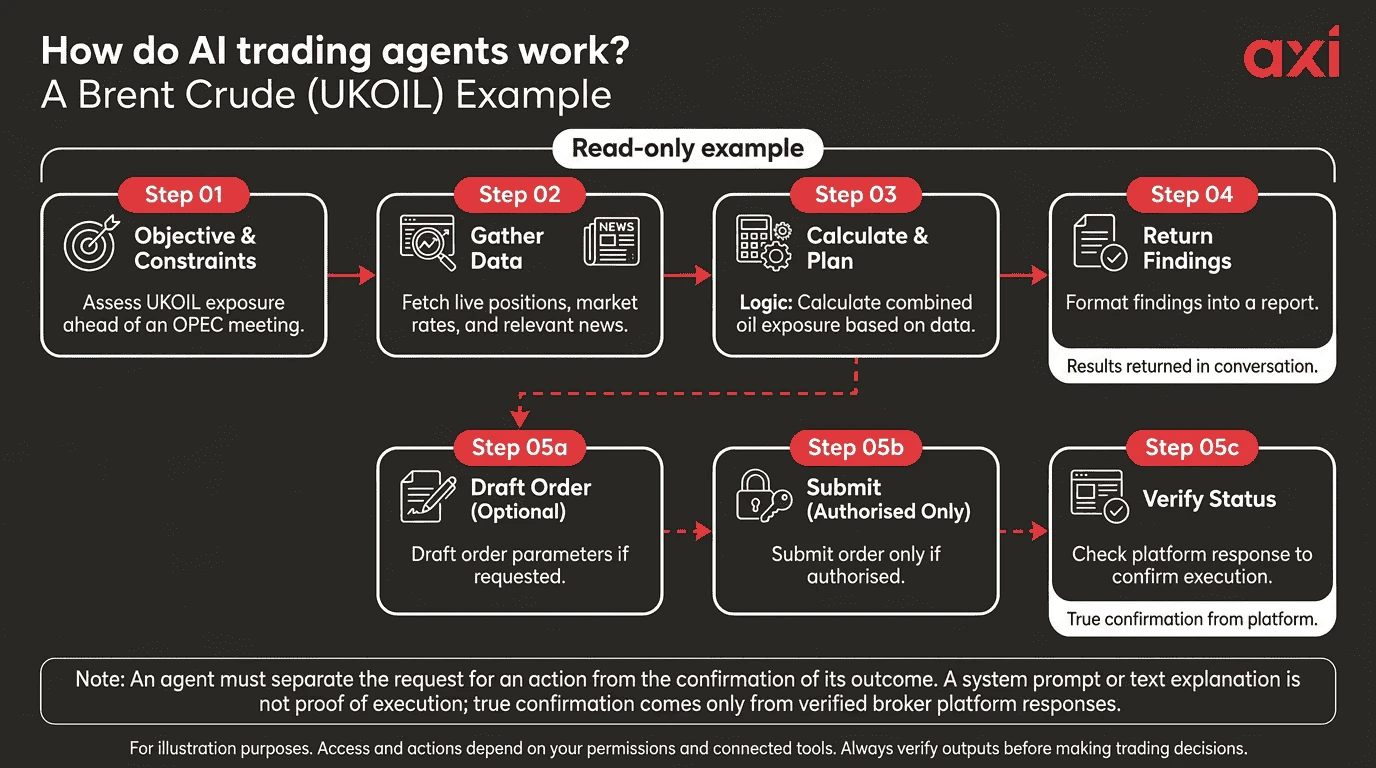
An AI agent executes tasks by following a series of steps:
- The agent begins by clarifying your objective and constraints (such as assessing UKOIL exposure ahead of an OPEC meeting).
- It then gathers live position data, market rates, and relevant news from connected sources.
- Next, it plans the logic, calculates combined oil exposure, and any calculations needed for your request.
- It then formats those findings into a report and drafts order parameters if requested.
- Finally, the agent checks the platform response to confirm whether the request succeeded in order to verify the results.
Note: An agent must separate the request for an action from the confirmation of its outcome. A system prompt or text explanation is not proof of execution; true confirmation comes only from verified broker platform responses.
3. How are AI agents used in trading?
AI agents connect distinct trading tasks, using output from one step to drive the next.
Market research and preparation
An agent with web tools can compile market reports and highlight conflicting evidence. For instance: "Summarise the main developments affecting Brent crude, separate confirmed facts from forecasts, and cite your sources."
Portfolio and exposure reviews
Agents with account access can combine market data with information about your positions. Ask Axi provides conversational portfolio analysis covering performance, exposure and potential risks. Axi MCP connects Claude to an eligible MT5 account, allowing it to retrieve account information and use supported trading functions according to your permissions.
Strategy development and testing
Agents with coding capabilities and access to suitable testing tools can convert strategy concepts into technical scripts (e.g., MQL5 for MetaTrader 5), run backtests, and point out logical flaws before live use.
Order preparation and position management
With execution tools enabled, an agent can translate a request into precise order details. Asking an agent to analyse a setup does not give it the permission to execute; this remains a distinct action which needs to be authorised.
4. Single-agent vs multi-agent trading systems
Single-agent systems manage tasks end-to-end. Multi-agent systems split responsibilities among specialised sub-agents:
| Agent role | Task |
|---|---|
| Market researcher | Collects news and macroeconomic data and can identify conflicts. |
| Account analyst | Reviews existing positions and calculates net exposure. |
| Reviewer | Flags missing details and tests key assumptions. |
| Coordinator | Combines all outputs into a final summary. |
Dividing tasks allows simultaneous research but can introduce latency or redundant work. Multiple agents agreeing does not guarantee accuracy if they rely on the same underlying data or models.
5. How do AI agents connect to trading platforms?
Agents connect via secure software interfaces, such as the Model Context Protocol (MCP), an open standard for passing data and instructions between AI models and external applications.
Axi MCP with Claude
Axi MCP links Anthropic's Claude to an eligible Axi MT5 account. You can prompt: “Show my open UKOIL positions and their unrealised profit or loss.” Claude retrieves the data via MCP and formats the response.
Approval settings
Axi MCP asks for approval by default before running platform actions. You can grant access per request or select "Always allow" for specific tools. Disconnecting the bridge stops further account access immediately.
For connection instructions, see our guide to MCP in trading.
What is the Model Context Protocol (MCP)? - Model Context Protocol
6. What are the benefits of agentic trading?
Agentic trading can reduce manual work by connecting research, account analysis, and permitted trading actions within a single workflow.
By using an agent with suitable connections to retrieve information and run calculations, you reduce the need to constantly switch between tools or manually copy position data into a spreadsheet to figure out total exposure.
The system can also build on initial findings to decide what to investigate next. If two market reports conflict, the agent can cross-check their publication dates, figures, and assumptions before summarising the disagreement for your review.
Structuring routine checks into defined tasks helps with portfolio management, allowing you to ask an agent to verify whether open positions have stop-loss orders or flag missing information for quick inspection.
Since interaction occurs in plain language, you can easily clarify requests or adjust your strategy as needed. After reviewing your current exposure, for instance, you might ask how a proposed position would alter your total portfolio risk without having to specify every underlying software step.
These practical benefits depend on reliable connections, clear instructions, and careful verification, as a shorter workflow is only useful if it produces results you can trust.
https://www.anthropic.com/research/building-effective-agents
7. What are the risks and limitations of AI trading agents?
AI trading agents can misinterpret instructions, use unreliable information and carry errors through several steps. When connected to trading tools, those mistakes can affect real positions. Trading risk remains, including losses amplified by leverage.
Small errors can carry through the workflow
An agent might retrieve an outdated oil forecast, treat it as current and use it to explain a move in Brent crude. Later calculations could be correct while the original interpretation remains wrong.
Access to live prices does not guarantee that supporting news, forecasts or account information are equally current. Check the source and timestamp of information that matters to your decision.
Risk of misinterpretation
Vague instructions pose another risk, as they allow for misinterpretation by the trading agent. An ambiguous command such as "Reduce my oil exposure" prompts multiple questions regarding which positions to adjust and by how much.
Connected tools introduce operational and security risks
Connections can fail, account requests can return incomplete information, or an order may not be accepted, so check the platform’s reported outcome rather than relying solely on the agent’s summary.
Agents that read external content also face prompt-injection risks: malicious instructions hidden in a webpage or document may attempt to redirect their behaviour. This makes control over tool access important, particularly where research and trading functions are connected.
A convincing explanation can encourage overconfidence
An agent may overlook transaction costs, misunderstand an instrument or produce a persuasive explanation from incomplete evidence.
Multiple agents agreeing does not necessarily resolve this problem. If they share sources or assumptions, they can reinforce the same mistake. Backtests and AI-generated analysis still require independent scrutiny.
Account access creates data and oversight responsibilities
Connected agents may receive sensitive information about your balances, positions and trading history. Understand what is shared and how the external provider handles it.
With Axi MCP, read-only and trading permissions can be managed separately. Certain approval settings may allow subsequent trading actions without individual confirmation. Disconnecting stops further access through the connection but does not automatically delete information already shared with Claude.
Before using an agent, establish what it can access, what it may change and how you will verify its actions.
https://www.finra.org/sites/default/files/2025-12/2026-annual-regulatory-oversight-report.pdf
8. Conclusion: The future of agentic trading
Agentic trading extends AI’s role from answering questions to completing connected tasks. For traders, its usefulness depends on reliable information, appropriate tools and clear limits. Start with a specific task, understand what the agent can change and verify the result. These principles provide a practical basis for evaluating new capabilities as they emerge.
9. Frequently asked questions about AI trading agents
Is agentic trading the same as algorithmic trading?
There is some overlap between the two. Conventional algorithmic trading follows programmed rules, while an AI agent can interpret an objective and choose the steps and tools needed to pursue it. An agentic system may still use conventional algorithms to execute orders.
Do I need coding skills to use an AI agent for trading?
Not necessarily. Ready-made integrations such as Axi MCP let you interact with supported trading functions through natural-language requests. Building a custom agent or connecting unsupported systems may require programming and ongoing technical maintenance.
Can an AI trading agent trade without my approval?
Some systems can, depending on their design and the permissions you grant them. With Axi MCP, Claude asks for approval by default, but selecting “Always allow” for a trading tool may permit subsequent actions without separate confirmation. Check the permissions for each tool rather than assuming every order requires another approval.
Does connecting an agent mean it monitors my account continuously?
No. Account access and continuous monitoring are separate capabilities. Ongoing monitoring requires a system designed to keep running or perform scheduled checks. A connection alone does not establish that the agent is watching your positions between conversations.
Can I use Axi MCP with an MT4 account?
No. Axi MCP requires an active, eligible MT5 account. Holding an MT4 account alone does not provide access to the connection, and trading functionality remains subject to account requirements and restrictions.
Can AI trading agents guarantee profits?
No. Agents can automate tasks and support analysis, but their decisions can be wrong, and trades can lose money. Faster research or execution does not establish that a strategy has a trading advantage.
Read also
- What is AI trading and how does it work?
- What is MCP in trading?
- What is trading and how does it work?
This information is not to be construed as a recommendation; or an offer to buy or sell; or the solicitation of an offer to buy or sell any security, financial product, or instrument; or to participate in any trading strategy. It has been prepared without taking your objectives, financial situation and needs into account. Any references to past performance and forecasts are not reliable indicators of future results. Axi makes no representation and assumes no liability with regard to the accuracy and completeness of the content in this

Alex Macris
With a background spanning forex, stocks, and crypto, Alex has contributed financial and stock exchange reports to leading publications and news agencies. Beyond financial markets, he honed his skills by researching and editing international agreements and state reports and producing multimedia resources for diverse brands and organisations.
In addition to written content, Alex, who is fluent in English, French, and Greek, brings extensive experience and passion for audio. His portfolio showcases a versatile skill set encompassing podcast production, educational materials, and advertisements. A team player and lifelong learner, he maintains a balanced perspective on both the big picture and the finer details.
Find him on: LinkedIn